


Your Home Shapes How You Feel: Why Longevity Architecture Could Be the Next Evolution of Luxury Residential Design


I have always been a natural-materials girl. Long before I knew phrases like longevity architecture, circadian lighting, or healthy home design, I was instinctively drawn to materials that felt honest, tactile, and built to last.
The ground floor of my own home is laid with reclaimed oak parquet that came from one of our local schools. Upstairs, I have solid ash floorboards. My kitchen has granite worktops, my windows and doors are timber, and the handmade oak staircase we installed in 2004 still looks as good today as it did when it went in.
I didn't make those decisions because somebody told me they were “wellness” choices. I simply loved natural materials, appreciated quality and knew how I wanted my home to feel.
Only now am I beginning to understand how those instincts connect to a much bigger conversation.
I started working in interiors and construction in 1993, and after more than three decades in the industry, alongside my growing fascination with health and longevity, I have found myself looking at the spaces we live in through a slightly different lens. We spend so much time talking about how our homes look. Perhaps we should be talking more about how they make us feel.
We spend thousands of hours every year inside our homes
Our homes are not simply collections of rooms, furniture and finishes. They are environments our bodies experience for thousands upon thousands of hours every year.
We wake up in them, sleep in them, eat in them, work in them, recover in them and spend time with the people we love in them. We continually experience the light, air, sound, temperature and materials around us, often without consciously thinking about any of those things. That has started to change the questions I ask as a designer.
I still care enormously about the stone, the joinery, the lighting, the proportions and all those tiny details that make a beautiful interior. But I'm also starting to ask where the morning daylight will come from, what the lighting will feel like at 9 pm, how the room will sound, what the air quality will be like, whether the temperature will be comfortable and whether a bedroom will genuinely support good sleep. Ultimately, it comes down to one deceptively simple question:
How do you want to feel living in your home? For me, that's where interior design becomes even more interesting.
From beautiful homes to longevity architecture
I've become fascinated by the developing conversation around longevity architecture. The terminology may be relatively new, but many of the principles aren't. I see longevity architecture as designing buildings around the people who will actually live inside them, bringing together architecture, interior design, building science, technology, and our growing understanding of human wellbeing.
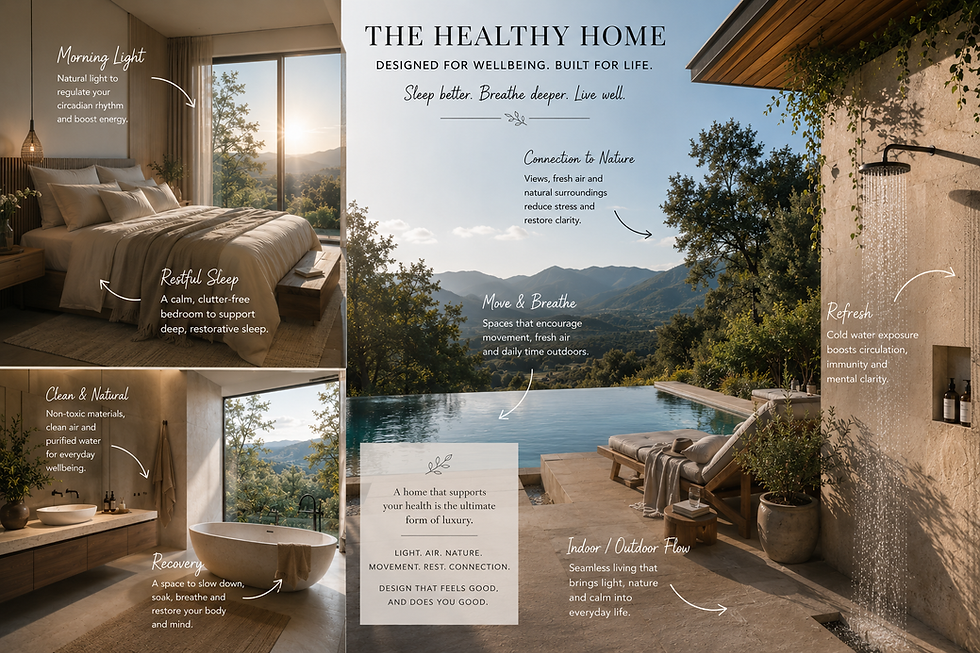
It doesn't mean turning our homes into laboratories, and it certainly doesn't mean filling every room with wellness gadgets. It means thinking more deeply about natural daylight and circadian lighting, indoor air quality and ventilation, acoustics, temperature and thermal comfort, materials, our connection with nature, sleep and recovery, movement, water and technology that genuinely improves how we live.
Some of those things can be incredibly sophisticated. Others are beautifully simple.
That is exactly what makes this area so interesting.
Daylight before downlights
Lighting has always been fundamental to good interior design, but my understanding of light has changed.
I used to think primarily about what lighting did to a room: how it revealed texture, created atmosphere, highlighted materials and made an interior beautiful. Now I'm equally interested in what light is doing to us.
Our bodies use light as an important environmental signal for our circadian rhythm, our internal 24-hour clock. Bright light and natural daylight during the day provide very different signals from darkness and lower light levels in the evening.
That raises an interesting design question. Why should our homes be illuminated in exactly the same way at 8 am as they are at 9 pm?
Increasingly, I'm interested in circadian lighting and homes that maximise access to natural daylight during the day, then gradually become softer, warmer, and darker as evening approaches.
It doesn't need to feel technical. In fact, I think it can make interiors more beautiful.
Morning should feel like morning. Evening should feel like evening. Ideally, the technology making that happen almost disappears.
Perhaps good-quality air is a luxury too
We spend an enormous amount of time choosing the things we can see in an interior, but what about something we cannot see at all? The air. Indoor air quality can be influenced by ventilation, humidity, cooking, outdoor pollution, furnishings, cleaning products and some of the materials and finishes we introduce into our homes.
I don't think this should frighten us. In fact, that is exactly the kind of conversation I want to avoid.
But if we're designing genuinely high-quality residential environments, surely the air quality inside them deserves consideration too?
Good ventilation, sensible moisture management, thoughtful material choices and, where appropriate, filtration and monitoring can all operate quietly behind a beautiful interior. This is where I think smart-home technology becomes genuinely smart. The technology disappears. The benefit remains.
We design with our eyes, but we don't experience our homes with our eyes alone
Acoustics are another part of design that's surprisingly easy to overlook. Stone, porcelain, glass, and large open-plan spaces can look extraordinary, but hard surfaces also change how sound behaves.
Sometimes you walk into a room and instinctively feel comfortable. Another can be equally beautiful but somehow feel harsher. You may not consciously think about its acoustic performance. You simply know which room you would rather spend two hours sitting in.
Good acoustic design can be almost invisible. Upholstery, rugs, curtains, wall treatments, ceilings, joinery and architectural decisions can all change the experience of a space. For me, that belongs in the luxury conversation just as much as the choice of stone or timber.
What temperature is your beautiful bedroom at 2 am?
We talk a great deal about visual comfort and comparatively little about thermal comfort, yet temperature can completely change how a room feels. This becomes particularly interesting when we think about bedrooms and sleep. A bedroom might look incredible in photographs, but ultimately its most important job happens when our eyes are closed. That thought has really stayed with me. A home should perform beautifully even when nobody is looking.
Temperature, darkness, quiet, comfortable bedding and appropriate lighting can all become part of designing for sleep and recovery. Once you start looking at the bedroom in that way, it becomes much more than a decorating exercise.
I've always loved natural materials. Now I'm seeing the bigger picture.
Looking back at my own home has actually been quite revealing. I've always chosen natural materials instinctively. My reclaimed school parquet has already had at least two lives. The solid ash flooring upstairs can be sanded and refinished. The granite worktops are still going strong. My handmade oak staircase was installed in 2004 and, more than twenty years later, I wouldn't dream of replacing it.
There is something about real materials I've always loved: their weight, texture, imperfections and the way they change over time. But I'm now seeing another layer to those choices.
Longevity doesn't only apply to people. It can apply to the things we build too. If something is beautifully made, repairable and capable of lasting for decades, perhaps replacing it with the latest trend isn't progress at all. Reclaimed materials also carry something you can't simply manufacture. They carry history.
My parquet once had hundreds of local schoolchildren walking across it. Now it belongs to another building and another chapter of its life. I love that. It makes me wonder whether craftsmanship, sustainability, material health and longevity are actually much more interconnected than we have traditionally treated them.
I don't want healthy design to become fearful design
This is really important to me. Once you start learning about health and longevity, it is very easy to find something alarming about almost everything. Air pollution, VOCs, plastics, chemicals, fragrances, heavy metals and building products can quickly become an overwhelming list of things to worry about.
That's not how I want to live, and it's certainly not how I want to design.
Our bodies have extraordinary systems for processing and eliminating many of the substances we encounter. At the same time, that doesn't mean every environmental exposure is irrelevant. What the substance is, how much we're exposed to and for how long all matter. For me, the sensible position lies somewhere between pretending none of this matters and becoming frightened of everything around us.
Knowledge is key. If I can choose a lower-emission product without compromising its performance or the design, that seems sensible. If we can ventilate a room better, let's do it. If we can avoid unnecessarily adding pollutants to an indoor environment, why wouldn't we? It's not about trying to create a perfectly “non-toxic” existence. It's about making informed choices where we reasonably can and then getting on with living.
Because the house is only part of the story
This may actually be the biggest lesson my interest in longevity has taught me. We can obsess about creating the perfect environment, but our bodies need supporting too. What we eat matters. I've become fascinated by a diverse, plant-rich diet and the role of fibre, polyphenols and the gut microbiome in supporting our health and normal bodily processes.
Movement matters too. The lymphatic system doesn't have a central pump like the heart, so movement, muscle contraction, and breathing all help lymph circulate.
Sleep matters enormously as well. One area I find particularly fascinating is the brain's glymphatic system, which clears metabolic waste from brain tissue and is especially active during sleep. Suddenly, designing an exceptional bedroom doesn't feel superficial. But longevity has another side that I think we sometimes forget.
Longevity is laughing too
You can have the perfect bedroom temperature, immaculate nutrition and the latest health technology, but what about the people sitting around your kitchen table?
Meaningful relationships matter. Friendship matters. Community matters. Laughing matters. Getting outside matters. Moving because you enjoy it matters. Having purpose matters. Going on adventures matters. Enjoying your food matters.
Actually living matters. I don't want longevity to become another thing we have to perform perfectly, and I certainly don't want our homes to become controlled environments we're frightened to actually live in.
A longevity-focused home should support life, not restrict it. Perhaps that's one of the most important principles of all.
The showroom started the conversation. Now I'm bringing it home.
Our spa room at the Kuche & Bagno showroom has been a brilliant place to explore what happens when bathroom design moves beyond the purely functional. It has allowed us to bring together water, light, sound, temperature and technology and to think more deeply about how those elements change the experience of a space.
It has also made me question what we really mean when we talk about a “wellness bathroom”.
Is it simply a beautiful bathroom containing wellness products? Or should we think more deeply about how the entire environment makes someone feel? That question has become particularly relevant because I'm currently in the throes of designing my own spa room and sleeping quarters at home. And I'm approaching those spaces very differently than I might have a few years ago.
Of course I want them to be beautiful. That will always be fundamental to how I design. But now I'm thinking just as much about the things you won't necessarily see in the finished photograph.
I'm considering natural daylight and how artificial light changes as the day progresses. I'm looking at circadian lighting, air quality, acoustics, temperature and material choices. I'm thinking about darkness and sleep, how the sleeping environment should feel at night and how the spaces can transition from stimulation towards rest and recovery.
I'm also questioning where technology genuinely earns its place. I don't want technology everywhere simply because it exists. I want the right technology, quietly integrated, where it can meaningfully improve the experience.
In many ways, my own home is becoming an opportunity to put everything I've been learning into practice. Not to create a perfect home or a laboratory for longevity, but to explore what happens when we consider the person living inside a beautiful residential interior as carefully as we consider its materials, furniture and finishes.
What if wellbeing became part of the brief from day one?
This is where I think the opportunity for our industry becomes really exciting. What happens when architects, interior designers, lighting designers, developers, building-services engineers, technology specialists, manufacturers and wellbeing experts begin these conversations together? Not after the house has been designed. At the beginning.
Alongside asking how many bedrooms somebody needs, how they use their kitchen and how they entertain, perhaps we should also ask how they want to feel in their home. Where do they want morning light? How well do they sleep? Where do they need quiet? How do they exercise? How do they recover? How do they use the outdoors? Where does everybody naturally gather? What makes them feel calm? And what does wellbeing actually mean to them?
Those answers could influence orientation, architecture, glazing, lighting, acoustics, ventilation, heating and cooling, materials, technology and interior design from the very beginning. To me, that's far more interesting than adding a sauna to the specification and calling it a wellness home.
Is this where luxury residential design is heading?
I think our definition of luxury is changing. Exceptional craftsmanship will always matter. Beautiful natural materials will matter. Proportion, detail, provenance and quality will matter. But perhaps the next generation of luxury homes will add another dimension.
They will make the most of natural daylight and consider circadian lighting. They will provide good-quality air, acoustic and thermal comfort, and thoughtfully selected materials. They will connect with nature and create environments that support sleep and recovery. Technology will work quietly in the background rather than constantly demanding attention.
Most importantly, these homes will support the way we actually want to live — helping us rest well, connect with others, move more naturally and feel comfortable in the spaces we spend so much time in.
None of this needs to make a home look clinical or overtly “wellness-led”. It can still be beautifully luxurious, highly considered and completely individual. You may not always see the difference, but you can feel it.
For me, this feels like the natural next chapter
I’ve worked in interiors and construction since 1993, and this doesn’t feel like a change of direction. It feels like an evolution of everything I’ve always cared about — quality, natural materials, craftsmanship, light and how a space feels. What excites me now is bringing those principles together with what we’re learning about air quality, acoustics, temperature, sleep, technology, biophilic design and wellbeing.
This is the space I want to work in. I want to collaborate with clients, architects, designers and specialists who want to create beautiful homes that support the people living in them from the very beginning.
Not homes that feel clinical or over-engineered, but homes that are considered, restorative and genuinely good to live in.
I still want to create spaces that stop you in your tracks because they are beautiful. I just want them to make you feel good too.


Comments