


The Healthy Home: Why Wellness May Become the Most Important Design Brief of Our Time

By Lisa Melvin
For more than twenty-five years, I have designed kitchens, bathrooms and living spaces. When I entered the industry in 1999, clients wanted larger islands, bigger bathrooms and more impressive appliances. Success was often measured in square metres, stone worktops and statement pieces. Today, I believe we are witnessing one of the biggest shifts our industry has ever seen. People are no longer simply asking how a home looks. They are beginning to ask how it makes them feel.
Over the past few years, my own health journey has changed the way I view the built environment. Like many people, I spent years concentrating on projects, business and the practicalities of life, rarely stopping to consider how the spaces around me might influence my wellbeing. However, through treatment, recovery, and a growing interest in health, sleep, and longevity, I began to look at my own home differently. I became interested in light, air quality, temperature, sleep, recovery and the relationship between our environments and our health. What surprised me most was that many of the most powerful interventions were not expensive treatments or complicated technology. They were often the simplest things available to us.

One of the greatest discoveries for me has been first light. Importantly, this does not mean sunshine. Even on a grey winter morning in Warwickshire, outdoor light levels can be many times brighter than the lighting inside our homes. Simply stepping outside shortly after waking allows natural light to reach the eyes and sends an important signal to the brain that the day has begun. This light helps regulate our circadian rhythm, influencing energy levels, hormone production, body temperature and, ultimately, sleep.
You do not need blue skies or direct sunshine. You simply need daylight. For me, first light often happens naturally through movement. A morning run, a walk outdoors or simply taking a few moments to look towards the eastern sky before the day properly begins has become an important part of my routine. Where possible, I remove glasses or tinted lenses and allow natural light to reach my eyes, even on overcast mornings. There is no need to stare directly at the sun. Looking towards the brightest part of the sky or the eastern horizon, where the sun rises, is sufficient. Research suggests that only a few minutes outdoors on bright mornings, or twenty to thirty minutes on heavily overcast days, can provide a meaningful signal to the body's internal clock.
As someone who has explored numerous health interventions and recovery tools, I repeatedly return to this simple practice. It requires no equipment, no subscription and no appointment. It simply requires us to step outside. In many ways, this experience has changed how I think about the homes we design. Where does the morning light enter? Is there somewhere to step outside easily? Can a home encourage its occupants to begin the day connected to the natural world?
Water has also become an important part of my relationship with wellbeing. I particularly enjoy swimming outdoors early in the morning, when the water is still, the air is cool and the day has yet to properly begin. There is something uniquely calming about an open-air pool at first light where the body, water and changing sky seem to work together. Some of my most memorable experiences have come from swimming in mountain lakes at altitude during the summer months. These environments, surrounded by mountains, cooler temperatures, and exceptionally clean air, provide an extraordinary sense of perspective. The combination of movement, daylight, fresh air and nature creates a feeling that is difficult to recreate indoors.
Perhaps this is why so many of us feel restored by mountains, lakes, forests and coastlines. We have an innate connection to nature that modern life sometimes encourages us to forget. Some of my clearest thinking has happened while running trails, walking in the Alps, sitting quietly outdoors or simply spending time with good friends. Fresh air, movement, conversation, and natural environments remain among the most powerful forms of medicine I have experienced.
Over time, I have also developed a very gentle lymphatic routine inspired by Eastern philosophies of movement and wellbeing. It is not something formal or structured. It often happens naturally during a walk or an easy run through deep breathing, relaxed shoulders, gentle arm movements, and simply allowing the body to move rhythmically. Many Eastern cultures have long understood the relationship between movement, breathing, circulation and health. Walking itself becomes a form of therapy rather than simply exercise. These quiet moments of movement have become increasingly valuable to me and have reinforced the importance of designing environments that encourage us to move, breathe and connect with our surroundings.

Sleep has perhaps become the greatest luxury of all. For many years, luxury was measured in cinema rooms, dressing rooms and oversized bathrooms. Today, I increasingly believe true luxury is sleeping deeply, waking refreshed and feeling recovered. Technology certainly has its place. Circadian lighting, healthier materials, improved ventilation, air purification, red light therapy, oxygen treatments and recovery technologies all have enormous potential. I use several of these myself and have found many of them extremely valuable. However, I have become convinced that these treatments work best when built upon much simpler foundations.
As designers, perhaps our role is beginning to change. We are no longer simply selecting finishes, appliances and furniture. We are helping to shape environments that influence how people live, recover and feel. The positioning of windows, the quality of natural light, the relationship between indoor and outdoor spaces, the use of natural materials, and the ability to connect with gardens, landscapes, and fresh air may become increasingly important considerations.
For much of my career, I have helped people create beautiful kitchens, luxurious bathrooms and practical living spaces. Those things still matter enormously and they always will. However, I now find myself asking different questions. How does this room make someone feel? Does it support sleep?
Does it encourage people outside? Does it create calm? Does it allow moments of recovery during increasingly busy lives?
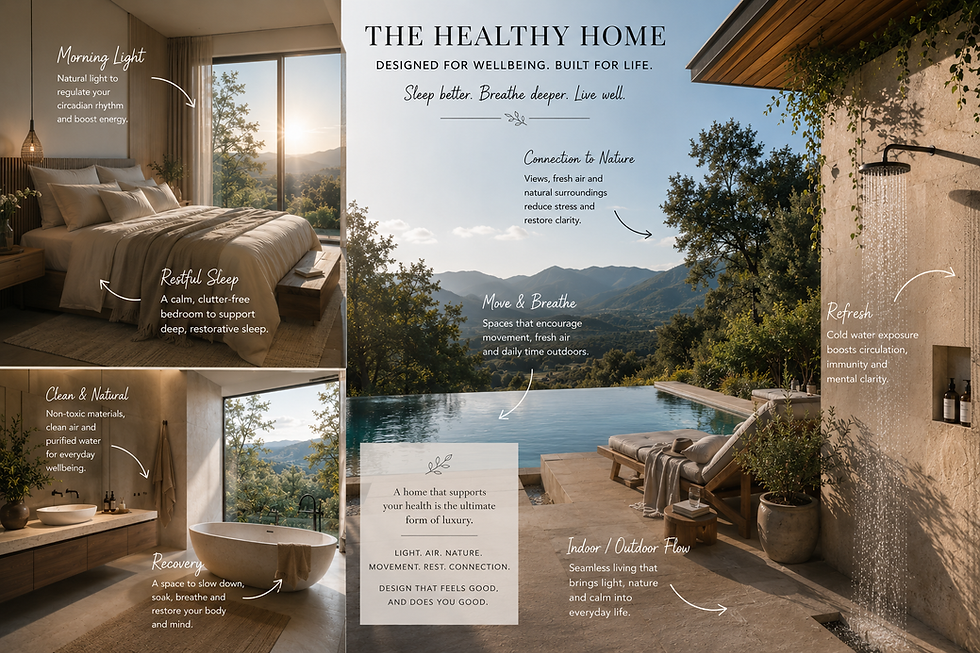
The built environment has an extraordinary influence over our daily lives. The light we wake up to, the air we breathe, the materials we touch, the quality of our sleep and our connection to nature all shape our health in ways we are only beginning to understand. As our homes increasingly become places of wellbeing and recovery, perhaps the greatest opportunity for designers is not simply to create beautiful rooms, but to create environments that help people feel their very best.
After everything I have experienced personally, I have become convinced that wellness does not begin in a clinic. It begins at home. It begins with stepping outside into the first light of the day, swimming in cool water, moving our bodies, breathing deeply, spending time in nature and surrounding ourselves with people who bring energy into our lives. Perhaps the greatest luxury of all is not a larger kitchen or a bigger bathroom. Perhaps it is simply designing homes and lives that allow us to feel well.


Comments