


Designing homes that care for clothes, food, and the way we cook

Inside the Fisher and Paykel London Experience Centre
Designing homes that care for clothes, food and the way we cook

I went to London excited to see Fisher & Paykel’s new laundry collection. I came away thinking more broadly about the home and how good product design can help us care for our clothes, preserve food longer, and make cooking feel more intuitive.
Yesterday I spent time at the Fisher & Paykel London Experience Centre on Wigmore Street. I always find visits like this valuable because appliances are shown within complete rooms, where I can judge their scale, finish and relationship with the cabinetry. A specification sheet can tell me what a product does. Seeing it in a considered interior tells me how it might feel to live with.
The centre moves through several very different settings, including an apartment kitchen, a pared-back Minimal Kitchen, a Fabric Care Wardrobe and the more atmospheric Subterranean Social Kitchen. What connected them was the way the technology sat quietly within the architecture. Screens, handles and openings were considered as part of the room rather than added afterwards.
A conversation that began in Milan
The visit continued a conversation that began in Milan earlier this year, when I met Vien McArthur Nguyen, Fisher & Paykel’s Head of Industrial Design, during the Nature – Ritual installation. As I wrote in my Milan Design Week blog, the presentation placed fabric care within a wider exploration of materials, daily habits and the way technology enters the home. It felt thoughtful and very human.
Meeting Vien made me think about how closely product design and interior design overlap. We both consider what a hand touches, how a door opens, whether a screen interrupts a sightline, and how an object will age within a room. London gave me the chance to look beyond the installation and see how that design thinking carries into everyday products.
Designing a laundry around the wardrobe

Utility rooms are often planned by allocating a space for a washing machine and dryer, then building storage around them. The new Fisher & Paykel laundry collection suggests a more interesting starting point: start with the wardrobe. What do the clients wear, which fibres need the most care, how often are clothes washed unnecessarily, and where do garments go once they leave the machine? Those questions change the room.
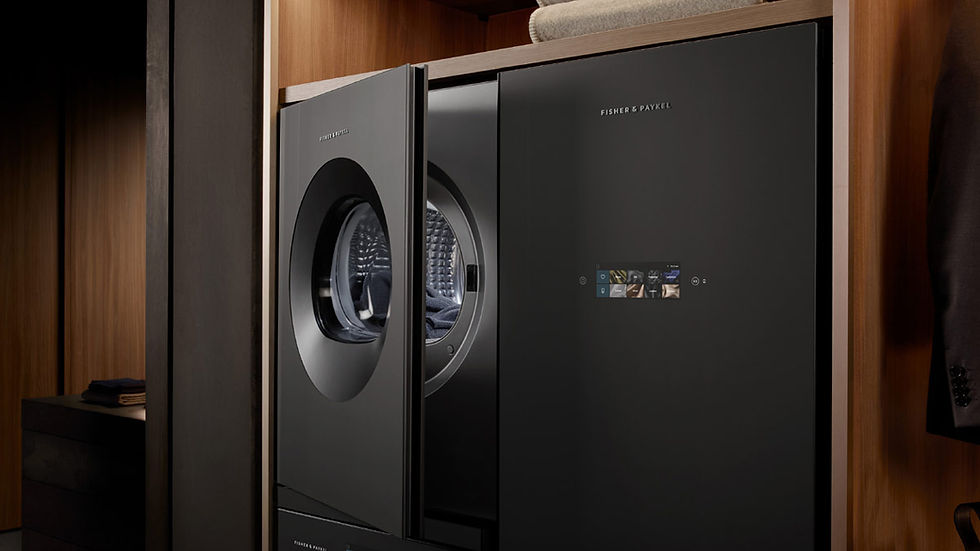
The collection brings washing, drying and refreshing together as one fabric-care system. Visually, the glass fronts, discreet handles and Graphite or White finishes feel closer to fitted furniture than conventional laundry appliances. That gives us more freedom to integrate them into a utility room, dressing room or boot room without the machines becoming the first thing the eye lands on.
The technology is centred on the garment. The washing machines can respond to fibre type, colour, and level of soiling, adjusting the wash rather than treating every load the same way. I was particularly interested in the flexible self-dosing system. Separate reservoirs can hold an everyday detergent and a specialist formula, with the machine dispensing what the selected load needs.
For delicate fabrics, sportswear or clothing that requires a very particular product, that makes far more sense than relying on one standard dose. Too much detergent can remain in the fibres and require more rinsing, while excessive heat and repeated washing gradually change a garment's colour, shape, and feel. If the appliance can make better decisions for each load, clothes should stay wearable longer.
The Fabric Care Cabinet
The Fabric Care Cabinet was the piece I kept returning to. It has the scale and calm presence of a tall wardrobe, using controlled warmth, humidity, steam and airflow to refresh clothing while it hangs. With no drum movement, fabrics such as wool, silk, cashmere and leather can be treated gently. Lightly worn pieces can be aired, odours reduced, and creases relaxed without automatically running a full wash cycle.
From a design point of view, the cabinet changes where fabric care can happen. It could sit within a generous laundry room or closer to a dressing room or bedroom suite. That relationship needs to be resolved early because it affects the joinery, ventilation, hanging space and movement between rooms.
My own laundry essentials would still include vertical drying rails, a generous sink for handwashing and soaking, concealed sorting, a proper folding surface and somewhere to hang garments as soon as they are ready. The cabinet adds another useful stage between wearing and washing. The room becomes a place to assess and care for clothes, rather than simply process them.
The living pantry as a food preservation space
The food-preservation area connected immediately with my idea of the living pantry. I see the pantry as a working part of the kitchen, not a display of perfect jars. It should support how a household shops, stores, prepares, and uses food, with refrigeration, ambient storage, preparation surfaces, and waste reduction considered together.
Fisher & Paykel’s variable-temperature refrigeration gives that idea much more scope. Individual zones can change purpose as the household needs them. A pantry setting of around 11 to 13°C can provide the right climate for foods such as bananas, tomatoes, avocados, bread, nuts and grains. Chill mode holds highly perishable foods just above freezing. Soft Freeze keeps ingredients colder while still making them easier to portion, with standard Freezer and Deep Freeze available when food needs to be stored for longer.
The examples shown to us in London made the difference tangible. In the right climate, bananas can remain yellow for up to three weeks, while meat can retain its useful life for up to four days. I liked that the conversation was about the ingredient rather than the refrigerator. Different foods need different conditions, yet most homes still ask one or two fixed temperatures to look after everything.
The thoughtful details include an internal dispenser for filtered, chilled water. Keeping it inside protects the clean external lines, especially when the refrigeration is integrated into tall cabinetry. It is a small decision, but these details determine whether technology settles into a room or visually takes it over.

Preserving food through better kitchen design
For me, the opportunity is to plan the pantry and refrigeration together as a food preservation centre. We can look at what a client genuinely buys, which ingredients are used quickly, what is often forgotten and how food moves from shopping bag to preparation. Storage should keep everyday ingredients visible and give more vulnerable foods the climate they need.
That is where sustainability becomes practical. Food waste is often connected to time, visibility and poor storage. If a carefully controlled zone keeps fresh produce usable longer or gives a household more time to cook the food it has bought, the appliance supports a less wasteful way of living. The most sustainable kitchen is not defined by one material or label. It is a room that helps people use what they have and buy with more intention.
Cooking technology that stays visually quiet
The new cooking platform follows the same approach. The ovens and hobs use larger, more consistent screens to make advanced functions easier to navigate. Guided cooking can lead the user through the method, temperature and type of heat, while the SmartHQ app provides monitoring, timers and alerts. The screen remains useful when you are standing at the appliance, with the app extending that information when you move away.
I was drawn to the Contemporary oven with its brushed stainless-steel character and glass front. It has a more familiar, almost traditional presence than a completely black appliance, so I can imagine it working beautifully with framed cabinetry, timber, and warmer materials. The technology is current, but the oven does not force the whole kitchen into a highly minimal style.
The induction hobs also offer more freedom in the way a cooking area is planned. SmartZone lets you join two zones for a larger pan or griddle, while the advanced modular options can be arranged around the cooking methods a client actually uses. With the wireless temperature sensor, the hob can monitor and automatically hold a target temperature, which is particularly useful for controlled methods such as poaching or sous vide.
These functions influence the interior long before installation. The size and position of the cooking zones affect the worktop, extraction, pan storage and the amount of clear preparation space around the hob. A central screen that can coordinate several cooking modules gives the designer more flexibility, but only if the appliance conversation happens while the room is still being planned.

Why this approach feels aligned
Throughout the visit, I kept returning to the same point: product design and interior design should begin with how people live. Fisher & Paykel’s focus on care feels very close to my own approach. The laundry starts with the wardrobe, refrigeration becomes part of a living pantry, and cooking technology makes complicated functions clearer.
I left the Experience Centre feeling more selective about where technology earns its place in a home. It should solve a genuine problem, sit comfortably within the architecture and remain easy to use. When those things come together, an appliance can do far more behind the scenes without making the room feel technical.
That was the strongest connection between meeting Vien in Milan and seeing the products in London. The technology is sophisticated, but the experience remains centred on familiar rituals: caring for clothes, preserving ingredients and cooking for the people around us. For me, that is where the most interesting design work is happening.


Comments